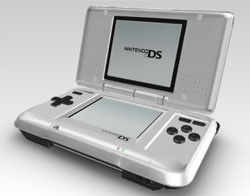
 | | The Nintendo Dual Screen adds a ton of new features over the old GameBoy |
|
I was one of the lucky few who got my DS from Nintendo-Europe.com about a month before the national release date, so I've had quite a while to mess around with it and gather my thoughts.
At first glance, the dual screen handheld will clearly remind those of a relatively long gaming lineage, of the original Nintendo portable; the Game & Watch. Especially the old multi-screen units, which were ridiculously expensive at the time (at least, for a five year old!). It's not so surprising that Nintendo would take the route of nostalgia as it really is Ninty's hardcore fanboys that keep it turning a profit after all these years (although the more recent Pokémon phenomenon wasn't losing them any money either).
It was this trip down memory lane that made me feel instantly at home with the console, even if the lack of an analogue stick was a little disconcerting in light of what Sony's rival PSP has to offer. In addition, the four main buttons are a touch (no pun intended) on the smallish size.
Touching Up
These issues are kind of irrelevant though, as the DS was always gonna be about its innovative new touch screen. Now I have to admit that I wasn't sure how the touch screen would react, shamefully suspecting it might just be a "new tech" selling angle and not really any good in action. I dunno how Nintendo managed it though, but the touch screen is actually one of the most ingenious additions to any gaming platform I've ever encountered.
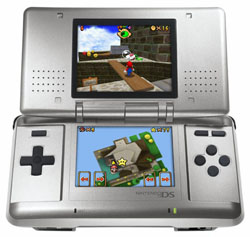 | | Super Mario 64 DS is an updated port of the old N64 classic |
|
It responds brilliantly to every tap or rub, with very little (if any) problems on contact. Sure, you can't really use your thumb, but Nintendo have included a thumb-strap to overcome this problem, giving the DS that more familiar analogue gaming sensation.
The thumb-strap works well, but the stylus is my personal choice of control, giving a greater degree of precision. It can even be stored in a special onboard holder at the top of the console as well, perfect for out and about playage.
Both of the DS' screens are quite large and give a good clarity to the action on screen, helped by backlighting, something Nintendo learned after complaints laid upon the original GameBoy Advance.
In addition, Ninty have gone a long way towards making them feel like a single entity, not two separate screens. For example when something drops down out of view from the upper screen, it'll appear in correct correlation on the lower one.
Now not every games developer will be utilising this sort of cohesion - the lazier ones will just keep the main action on one screen, with the other used for maps/items/etc - which is a shame as it can add so much more interaction to the game. Nowhere is this better demonstrated than in Wario Ware Touched, where a number of the mini-games utilise both at once.
Battery Life
I haven't timed myself while playing the DS, but I'll agree with official claims that the battery will easily last a good ten hours before requiring another recharge. This is good news for fans of long-term gaming, but I don't think many people would need to play for such an extended period without access to a power point. Sure, it's a nice feature, but it wouldn't for example make me choose a DS over a PSP, which by all accounts lasts half as long.
Additional Features
This is where the strengths of Nintendo shine through; they makes games. They have no desire, as far as I know, to make entertainment/multimedia do-it-all units, so you'll subsequently find no included media player with the DS. It's not a bad thing; if you wanted an MP3 player or portable DVD player, chances are you'd already own one. Nintendo have apparently deemed it no use in diluting the gaming experience with flashy non-gaming-essential extras.
If just having a great handheld console wasn't enough, the DS is, as you may be aware, fully backwards compatible with GameBoy Advance games. Seeing as few titles have been released for the DS at launch, this option gives the user a massive back catalogue of fantastic mobile gaming at his/her fingertips. You can even choose which screen you want to display the GBA games on!
I was shocked to see the size of the cartridges. They are so fookin' small that it beggars belief how all the game data can be stored on 'em. If you were to imagine drawing a box around a £2 coin, that is essentially the size of a DS game, and for completists' sake, they're about as thick as a £2 coin and a 50p piece stuck together.
The Games
 | | A demo of Metroid Prime: Hunters comes included with the DS |
|
Even though Nintendo hasn't done so well with its last two home consoles, at least in comparison to Sony and Microsoft, I don't think anyone would argue that they can't still produce solid games. This is the Japanese bigwig's forte, so if anyone can showcase the potential of the DS, it's these boys on their home-turf.
When you receive your brand new DS, you'll find it bundled with a Metroid Prime: Hunters demo - a heavily adapted version of the GameCube Metroid titles. This is what Nintendo hope will confirm your DS purchase as warranted, and to be honest, even in demo form the game is stunning.
As with most titles on the DS, the control can either be handled via the touch screen, or the traditional D-pad. Using the touch screen enables you to shoot at exactly what you want to without having to line up shots. This method can be a little confusing to get used to, but once mastered it becomes second nature, with you jumping around and blowing away every enemy that crosses your path.
Now the demo is, by Nintendo's own admission, only a small teaser of the full single player game, with some additional multiplayer maps as well. Alas, I don't know anyone else with a DS yet, so haven't been able to test out any multiplayer features myself, but your more game-orientated friends will surely have a blast never the less.
Wireless Connectivity
So far I haven't mentioned anything about the DS' wi-fi capabilities. Included with the machine you get a simple chat program titled Pictochat, which automatically detects other users in your area and logs you all into a chat-room with simple drawing capabilities. This is perhaps aimed more towards the Japanese market, but it demonstrates the wi-fi abilities of the DS nicely.
Put simply, everyone within range can link up and share games or chat together. The great thing about this though, is that multiplayer games can be played with only one cart. For example Ridge Racer DS can have up to six players racing at once with this method.
That lone cart does mean the number of maps and in-game cars is somewhat limited, but it saves the hassle of five other peeps having to buy the game just for some multiplayer action, yet still gives extra incentive to all those who do. It's this kind of generosity that you have to salute Nintendo for, as it could potentially cost them a few extra game sales.
The Future of the DS
While I'd love to go into more details about all the games I've played so far (Super Mario 64 DS, Ridge Racer DS and Wario Ware Touched), I'll stick to the console itself for now. As much as I love my GameBoy Advance, the DS has really raised the bar for handheld gaming. Nintendo don't see themselves being in direct competition with Sony's PSP and I can see why. Sure, they both play games, but the PSP could ultimately be little more than a portable media player which runs cut down PS2 titles. We'll have to wait and see.
Similarly, will the DS be able to perform as more than just a novelty handheld, limited in long-term shelf life? With enough effort from Nintendo, I think so. The lifespan of the DS will however, be partly dependant on the ability of third party developers to utilise the touch screen as an integral part of the gameplay experience.
If they manage to get this right, then the sky's the limit. But then the gaming industry has come to expect nothing less from the big N.